

Menopause

What would you like to understand?
Select the topics you are most interested in, or choose “Show me everything” to see it all at once.
What menopause actually is
Menopause is a single point in time: the day you reach twelve months without a period. The years of symptoms most women call menopause are really the transition around it. In your 50s you are usually at or just past that point, which is why symptoms tend to be at their most noticeable.
The cause is straightforward. Your ovaries are winding down, and the estrogen your body makes has fallen sharply. Estrogen does far more than manage periods, so when it drops, several systems feel it at once.

What estrogen decline does
Estrogen helps regulate temperature, sleep, mood, and the health of many tissues. When it declines, those systems lose some of their normal signalling. That is why the symptoms can feel scattered and unrelated when they are really coming from one source.
The common symptoms, and why
Hot flashes and night sweats
Lower estrogen disrupts the brain’s temperature control, so your body overreacts to small changes and triggers a flush or a sweat. At night, this is what wakes you.
Disrupted sleep
Night sweats interrupt sleep directly, and the same hormonal shift makes it harder to fall back asleep. Over weeks, the lost sleep feeds fatigue and low mood.
Brain fog
Estrogen plays a role in focus and recall. Many women notice their thinking feels slower or foggier during this stage. It is common, and it usually settles.
Mood changes
Hormonal shifts, broken sleep, and the symptoms themselves combine to affect mood and patience. This is a physical change, not a personal failing.
Your options
There is no single right answer, and what suits one woman does not suit another. These are the main approaches, with the trade-offs stated plainly. Any decision is worth discussing with your own healthcare practitioner.

Hormone therapy (HRT)
Replaces the estrogen your body has lost and is effective for many women. It is a medical treatment with benefits and risks that depend on your health history, so it is a conversation to have with your doctor. Some women cannot use it, or prefer not to.
Lifestyle changes
Sleep routines, regular movement, managing triggers like caffeine and alcohol, and reducing stress all help and cost nothing. They are worth doing alongside anything else, though on their own they may not be enough for stronger symptoms.
Non-hormonal supplements
These aim to relieve symptoms without adding hormones to your body. Quality and evidence vary widely, so the useful questions are simple, and they are below.
Two questions cut through most of the noise
The menopause aisle is full of products that promise relief. Most never show their evidence. Before trying any of them, ask two things.
Has it actually been studied in clinical research?
Not “inspired by science” or “formulated by experts.” Published studies on the actual product or compound.
Is it approved by a regulator?
In Canada, that means a Natural Product Number (NPN) from Health Canada, printed on the package.
Plenty of popular supplements fail at least one of these. It is the fastest way to tell a real option from a good-looking label.
Is it hormones?
This is the most common worry women raise, especially when HRT is not an option for them. Non-hormonal means a product relieves symptoms without introducing estrogen or other hormones into your body. It is worth knowing exactly which type of product you are looking at, because the word “natural” on a label does not tell you that.
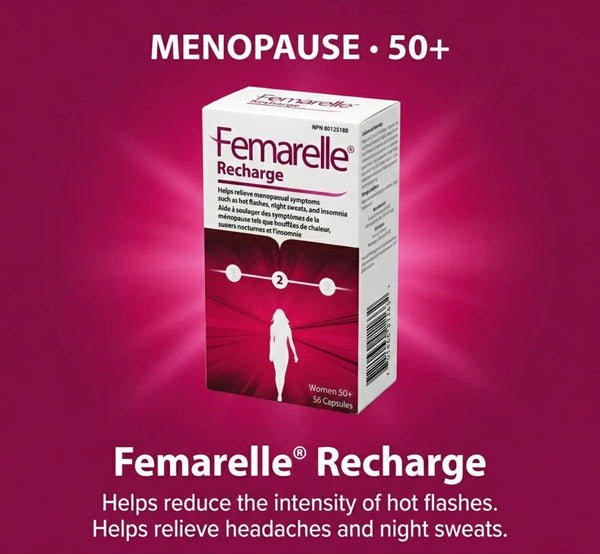
One non-hormonal option, built for this stage
Femarelle Recharge works through DT56a, which acts on estrogen receptors in target tissues without introducing hormones into your body. That is what lets it ease symptoms without being a hormone therapy. It has been studied in published clinical research for more than twenty years, is licensed by Health Canada, and is used by women in more than 40 countries. On the two questions above, that is a yes to both.
A 12-week study found that women taking DT56a reported a significant reduction in hot flashes and night sweats. (Yoles et al., 2004)
Read the study on PubMed →A review of the clinical evidence reported meaningful relief of menopausal symptoms, with no adverse effect on breast or uterine tissue. (Sánchez-Borrego et al., 2015)
Read the study on PubMed →Over 12 months, researchers recorded no negative effect on lipid levels or other cardiovascular markers. (Labos et al., 2013)
Read the study on PubMed →This page is general information about menopause and is not medical advice. It is not intended to diagnose, treat, cure, or prevent any condition. Talk to a qualified healthcare practitioner about your symptoms, and before starting any new supplement, especially if you take medication or have a health condition.